Wave Tank I - The Duck Gen.
At one end of the tank we have a handle that can be moved up and down to create water waves. The waves cause the floating duck to bob up and down. The duck is connected to a lever that transfers this motion to a set of magnets. As these magnets move up and down within a coil of wire electricity is generated. This then powers the meter and the set of LED lights. Marine buoys use a similar system (not with ducks but with moving weights within the floating buoy) to charge batteries so that they can continually power a light.
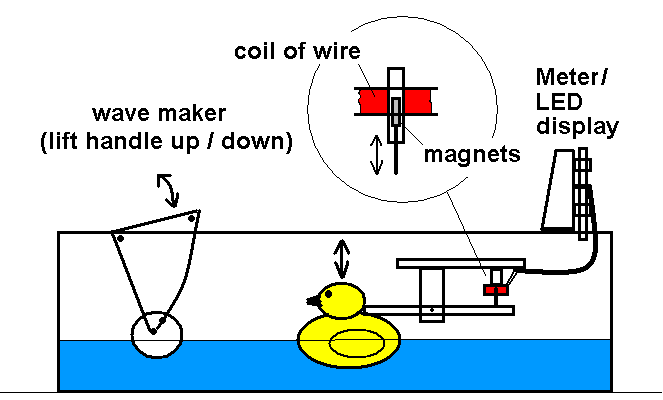
This equipment is currently traveling around southern England as part of the "who is going to keep the light on?" SEPnet exhibition for GCSE students. If you go to the events you might like to think about the following:
Things to do: use the handle to create waves but please be gentle so that you don't damage the equipment. You might find that the largest / fastest movement of the handle does not always create the most electricity. Are the quick (short) waves or the slow (long) waves best? Can you see how the waves move the parts of the apparatus that generate electricity? Can you think of anything that might improve the efficiency? What are the limitations of harnessing wave power using this method?
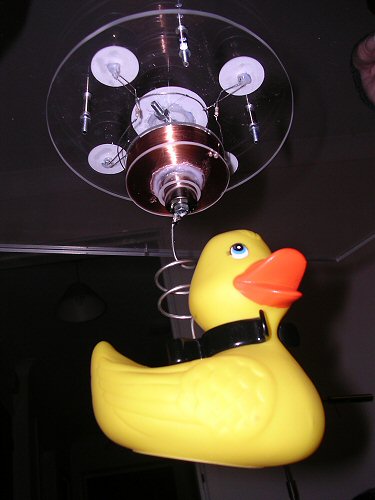
An alternative Duck gen. In this very simple design the duck hangs from a piece of thick wire which goes to a strong rare earth magnet. The magnet lies within a coil of wire (10,000 turns in this case). The other side of the magnet goes to a spring (not visible in the photo) which supports the duck and magnets. The spring is also attached to the top of the apparatus (the bolt just seen near the top). By adjusting the thick wire coil we can arrange the position of the duck so that when it is floating on the water the magnets are within the coil of wire. As a wave passes the ducks bob up and down, causing the magnets to move in and out of the coil - generating electricity in the coil. With a large magnet and 10,000 turns I could light 4 hyperbright LEDs (each fed with 1k series resistors) as the duck moved in fairly small 3 - 4 cm high waves.
For details of the electrical generators used in these designs please see: 6 gens
SEPnet web site
CSC talks and workshops
THE CREATIVE SCIENCE CENTRE
Dr Jonathan Hare, The University of Sussex
Brighton, East Sussex. BN1 9QJ.
home | diary | whats on | CSC summary | latest news